

A spare part may cost four dollars. Getting it to the customer, confirming that it fits, and handling a second complaint may cost much more. That is why a desk lamp's after-sales plan belongs in the buying decision, not in an email exchange after the first return.
For an importer or private-label brand, the question is not simply whether a supplier has spare parts. It is whether the right part can reach the right customer, restore the approved product safely, and cost less overall than replacing the lamp.
1. Choose the service route before choosing the spare
A complaint is a symptom, not a diagnosis. “The lamp will not turn on” could involve the supply, cable, controls, or the lamp itself. Automatically mailing an adapter may create a second shipment without fixing the problem.
Start with a short intake record: model and revision, order or batch identifier, symptom, when it appeared, and relevant photographs. Use only manufacturer-approved, non-invasive checks suitable for the customer. Do not ask a customer to open electrical assemblies to help identify a fault.
Reports of smoke, burning, exposed conductors, electric shock, or a swollen battery are not ordinary parts-selection cases. Tell the customer to stop using the product, keep it out of service, and escalate to the responsible safety contact. Do not request powered demonstration videos or arrange routine return shipping for a damaged battery without appropriate specialist guidance.
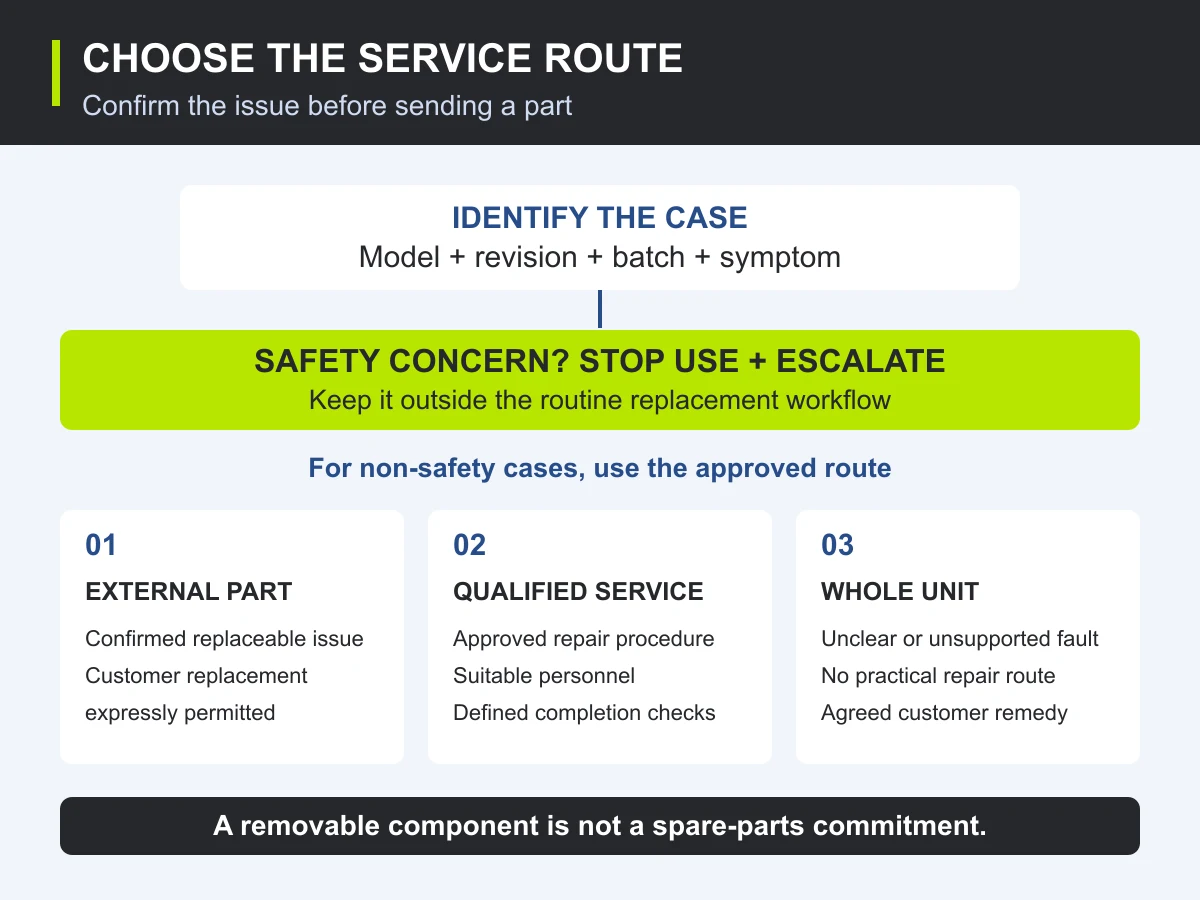
| Route | When it can make sense | What must be in place |
|---|---|---|
| Approved external part | A replaceable accessory is confirmed as the issue and customer replacement is permitted | An exact compatible part, clear instructions, and a completion check |
| Qualified service | The repair requires skills, tools, opening an assembly, or post-repair testing | An authorized procedure, suitable personnel, traceable parts, and defined checks |
| Whole-unit resolution | The fault is unclear, no approved repair route exists, or service is impractical | A replacement, return, credit, or refund process with agreed responsibilities |
Repairability is useful only within a safe, supported process. The UK's HSE guidance on work on electrical equipment emphasizes appropriate competence and preserving equipment safety after repair. That is a useful service-planning principle; this article does not prescribe a repair procedure or summarize every market's legal requirements.
2. Make compatibility a record, not a guess
A connector that fits does not prove that a part is suitable. Nor does a shared model name prove that two production revisions use the same driver, wiring, firmware, mounting detail, or finish. A spare-parts programme needs a more precise identity than “black adapter” or “round head.”
Create a parts register that links each service part to the finished-product versions it supports. Keep the human-readable part code on the bag or box, not only in a supplier spreadsheet that the warehouse cannot access.
| Record field | What to specify | Error it prevents |
|---|---|---|
| Part identity | Unique code, description, revision, colour or finish where relevant | Picking a similar-looking component |
| Product compatibility | Approved model, hardware revision, and applicable batch or serial range | Sending a new revision to an incompatible older lamp |
| Electrical and mechanical match | Manufacturer-approved specification, connector/interface, attachment, and any control dependencies | Treating physical fit as proof of electrical or functional compatibility |
| Service scope | Who may replace it, required instructions, and post-replacement checks | Sending a technician-only part to an end user |
| Supply control | Supplier code, price, minimum quantity, replenishment lead time, and change status | Planning around a part that cannot be reordered |
GS1's traceability framework distinguishes identification at product, batch/lot, and individual-instance levels. For a lamp service programme, the practical lesson is to connect the complaint and replacement part to the relevant product version. The register proposed here does not require a particular barcode system or imply GS1 certification.
A removable lamp head is a question to investigate
The RoyeLamp RY229-B product page describes a removable circular head and an articulated clamp format. This gives a buyer a concrete question to ask: can that head be supplied as an approved service part for the ordered revision?
The product description alone does not answer whether separate heads are stocked, what they cost, whether customers may replace them, or how compatibility and post-replacement performance are checked. Confirm those points before using “replaceable head” as a retail service promise. A design feature and a spare-parts commitment are different things.
3. Compare the cost of closing the case
The useful comparison is the total expected cost of a resolved case. Include the part or lamp, fulfilment, customer support, any return handling, and the cost of a failed first attempt. Then add the programme costs that exist even if few customers need service.
Here is a fictional USD example for a confirmed issue eligible for an approved external-part replacement. These are planning figures, not RoyeLamp prices, product failure rates, or a savings promise.
| Cost assumption | External-part route | Whole-lamp route |
|---|---|---|
| Part or lamp | $4 | $22 |
| Dispatch and delivery | $5 | $8 |
| Case handling | $3 | $5 |
| First-attempt total | $12 | $35 |
| Fallback assumption | 10% need a subsequent $35 whole-lamp resolution | No further cost in this simplified example |
| Expected cost per eligible case | $12 + (10% × $35) = $15.50 | $35 |
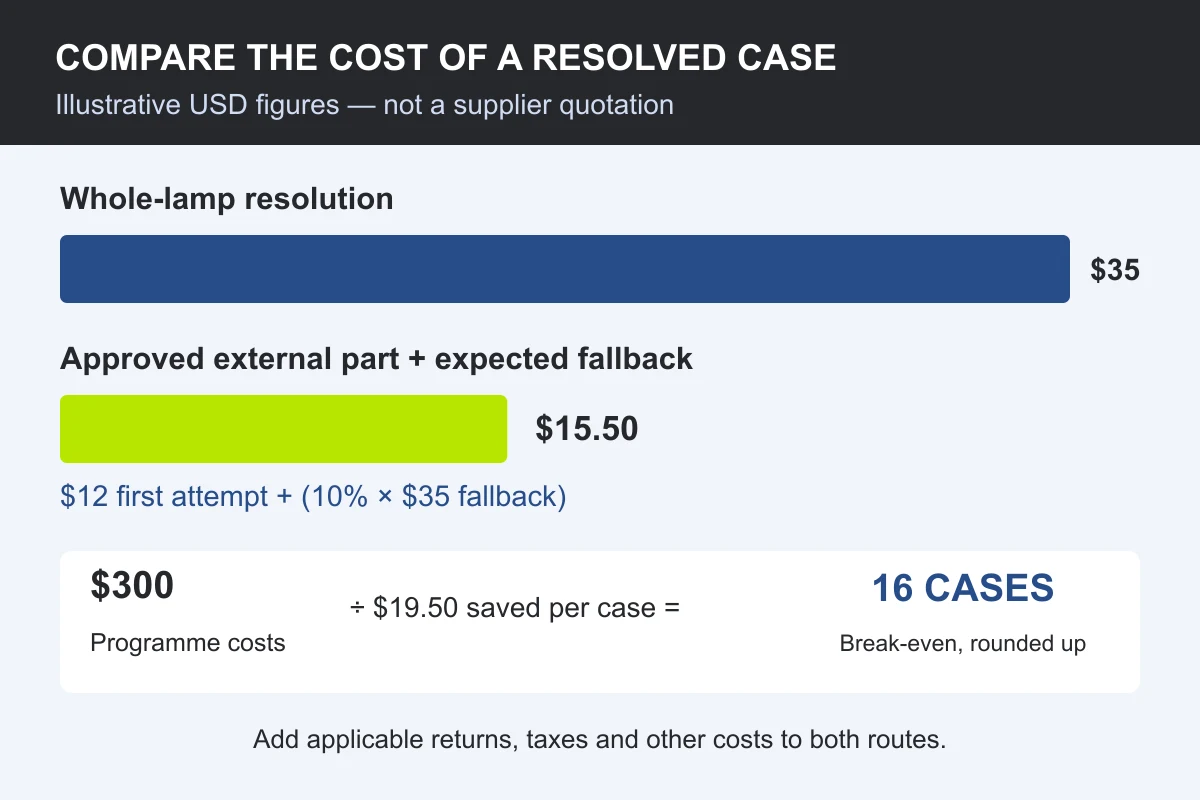
The expected difference is $19.50 per eligible case. If documentation, training, and other additional programme costs total $300 for the planning period, the programme needs 16 eligible cases to cover that amount: $300 ÷ $19.50 ≈ 15.4, rounded up. At 20 cases, the modelled net saving is only $90—not the $620 suggested by comparing a $4 part with a $35 whole-lamp resolution.
Keep consumed parts separate from programme costs to avoid counting them twice. Add actual return transport, disposal, taxes, repeat support, and unused-stock costs where applicable. Use the same boundaries for both routes. If compatibility errors or uncertain diagnosis make repeat shipments common, update the fallback assumption before ordering more stock.
This is also why a low-volume distributor and a large private-label brand may rationally choose different service routes for the same lamp. Volume alone is not enough: what matters is the number of cases that can actually use the approved part.
4. Stock against demand and replenishment, not a generic percentage
“Include 2% spare parts” leaves too many questions unanswered. Two percent of which component, for which revision, over what service period, and with what replenishment time?
Use eligible case demand during replenishment lead time as a starting point, then add a buffer appropriate to the uncertainty and service target. Track each part separately. An adapter reserve cannot cover a shortage of a model-specific clamp, and stock for one revision may not help another.
For a new model without service history, record conservative and higher-demand scenarios instead of presenting an invented failure rate as evidence. Agree a small initial reserve, a replenishment route, and a review point using real complaint data. Include seasonal demand and transport time where they materially affect the plan.
Define what happens when a part changes or is discontinued: notice period, compatibility review, final-order opportunity, and treatment of remaining old stock. Do not promise customers a support period longer than the documented supply arrangement can support.
5. Put the after-sales arrangement beside the product specification
Before approving the order, ask the supplier to confirm these items for the exact configuration:
- Coverage: supported cases, exclusions, and the evidence needed to choose a service route.
- Parts: approved codes and revisions, compatibility records, replacement instructions, and who may perform the work.
- Availability: initial quantities, replenishment prices and lead times, support period, and discontinuation notice.
- Cost ownership: who pays for parts, international freight, local dispatch, returns, labour, and unsuccessful first attempts.
- Closure: the completion check, fallback process, and record that confirms the case is resolved.
Please quote the after-sales arrangement for our selected lamp configuration. Identify the parts available separately, their approved product revisions, prices, minimum quantities, lead times, and proposed supply period. State which replacements customers may perform and which require qualified service. Include the claim evidence, compatibility checks, replacement instructions, cost responsibilities, and whole-unit fallback process. List anything that remains subject to confirmation rather than treating it as included.
Attach the agreed register and service instructions to the golden-sample approval record. At pre-shipment inspection, check that the supplied spare quantities, labels, revisions, and packing match the order. A correct lamp shipment with unidentified spare bags still creates a service problem.
Finally, feed confirmed cases back into purchasing. Group them by model revision, batch, component, and resolution—not just “customer returned item.” Recurring faults should trigger a product-quality review; buying more spares is not a substitute for addressing the underlying desk lamp defects.
Questions buyers often ask
Does a warranty automatically include spare parts?
Do not assume so. Check the written remedy and cost allocation separately from parts availability. The commercial plan should also be reviewed against the obligations that apply in the destination market; it does not replace them.
Physical fit is insufficient. Use the manufacturer-approved compatibility record for the complete electrical and interface specification. Do not substitute an adapter based only on connector appearance or a single matching rating.
Should every component be held as a spare?
No. Prioritize parts with an approved service route, identifiable demand, manageable storage, and useful economics. Some failures are better handled through qualified service or a whole-unit resolution.
Make after-sales support part of the enquiry
Tell RoyeLamp your selected model, sales market, order volume, service location, and preferred customer-resolution process. Ask which parts and support terms can be quoted for that configuration before committing to a retail promise.
Source notes: RY229-B product details, GS1 traceability guidance, and UK HSE electrical-work guidance were checked September 9, 2026 and are linked where used. Cost figures and diagrams are original editorial examples. Parts availability, prices, repair authorization, and support periods require written confirmation for each order.
