

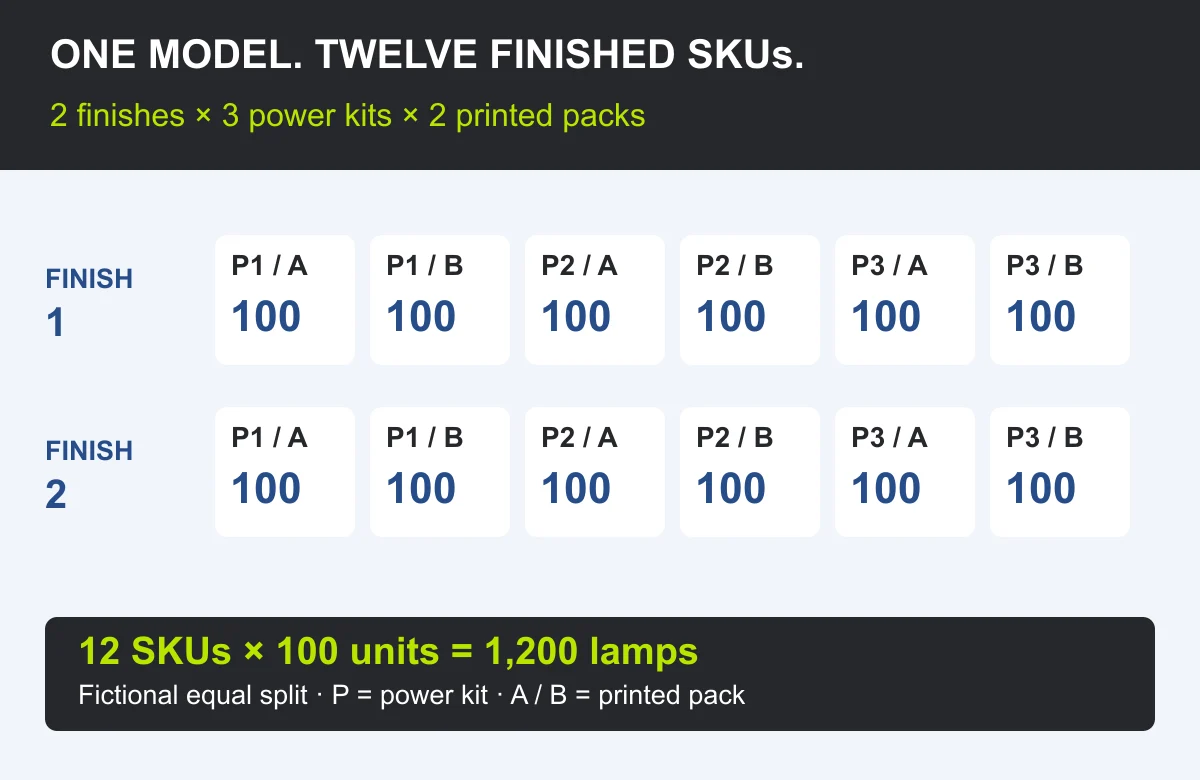
A desk lamp sample can look attractive in a meeting and still be too vague to control mass production. If the buyer approves only the overall appearance, the factory may still have unanswered questions about the adapter, LED board, dimming sequence, hinge force, charging behavior, logo position, label text, accessories, or packaging. Those gaps often become expensive arguments after materials have been purchased.
A golden sample closes that gap. It is the controlled, buyer-approved reference for the exact product that should be manufactured. For importers, distributors, and private label brands, the goal is not simply to keep one lamp on a shelf. The goal is to connect a physical sample to measurable specifications, approved artwork, test evidence, revision history, and a clear production-release decision.
1. Define What the Golden Sample Controls
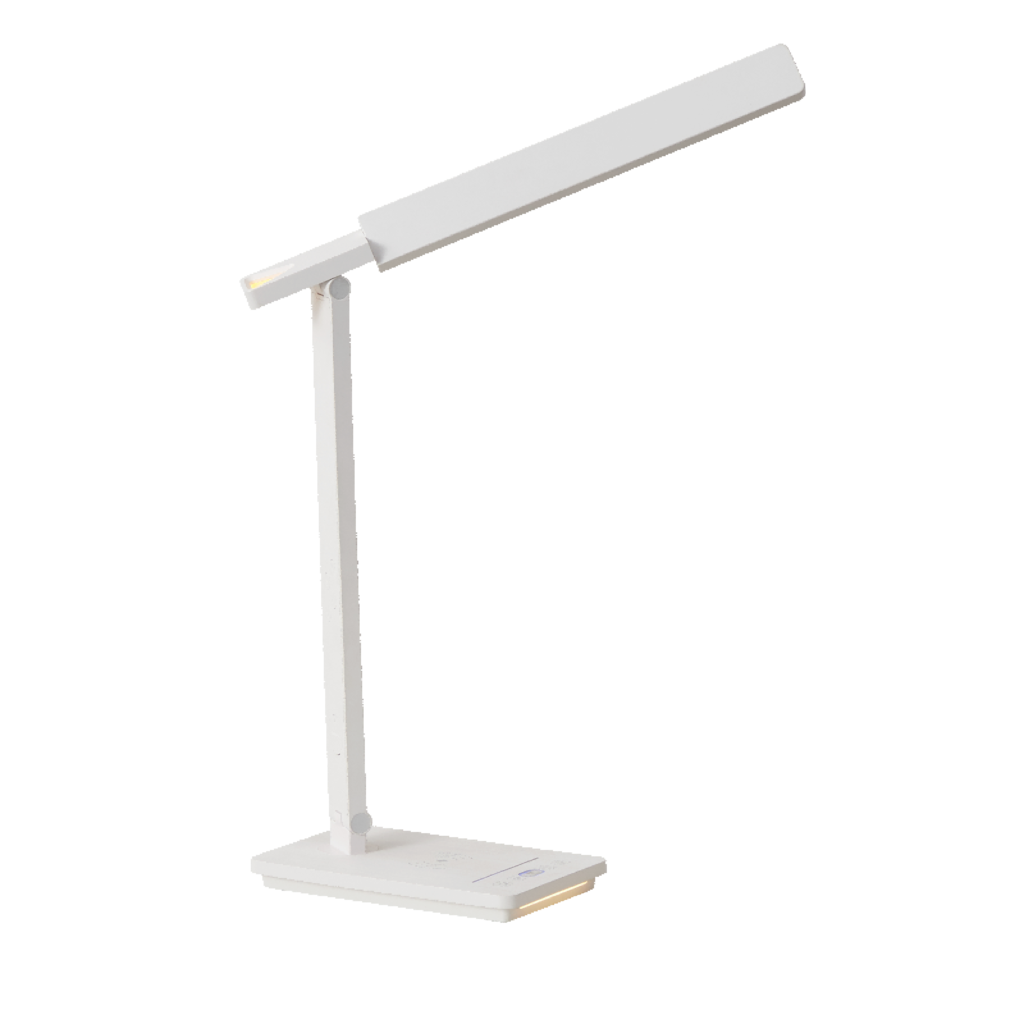
A golden sample is a commercial production reference, not a substitute for a technical specification or market compliance review. State in writing what it controls: appearance, materials, dimensions, construction, lighting functions, charging functions, accessories, branding, labels, manual, retail packaging, and master-carton configuration.
The sample should be identified by buyer name, supplier name, model, color, electrical configuration, sample revision, approval date, and unique sample ID. Attach dated photographs of all sides, the rating label, adapter, controls, accessories, packaging, and any cosmetic details that could change. One controlled sample can remain with the buyer and a matching sealed sample with the supplier.
The physical lamp shows what was approved; the specification explains how to reproduce and inspect it.
2. Confirm the Product Identity and Revision
Begin with configuration control. A model name alone is not enough when different adapters, LED boards, charging modules, finishes, firmware versions, plugs, or packaging files can share the same housing. Create a compact bill of approved characteristics and give every document a revision number.
| Approval record | What to identify | Common ambiguity to remove |
|---|---|---|
| Product | Model, color, finish, dimensions, materials, sample ID | Similar housings with different internal functions |
| Electrical set | LED board, driver, adapter, cable, plug, charging module | Alternative components described as equivalent without evidence |
| Branding | Logo file, color, size, method, position, orientation | Approval based only on a digital rendering |
| Documents | Rating label, manual, warnings, barcode and declarations | Different model numbers or ratings across files |
| Packaging | Insert, bag, retail box, accessories and carton revision | A product sample approved without its final packing |
If the project is still deciding between an existing platform and a new design, resolve that sourcing route first. Our OEM versus ODM desk lamp guide explains how the level of customization changes development work, cost, ownership, and approval risk.
3. Approve Appearance with Measurable Boundaries
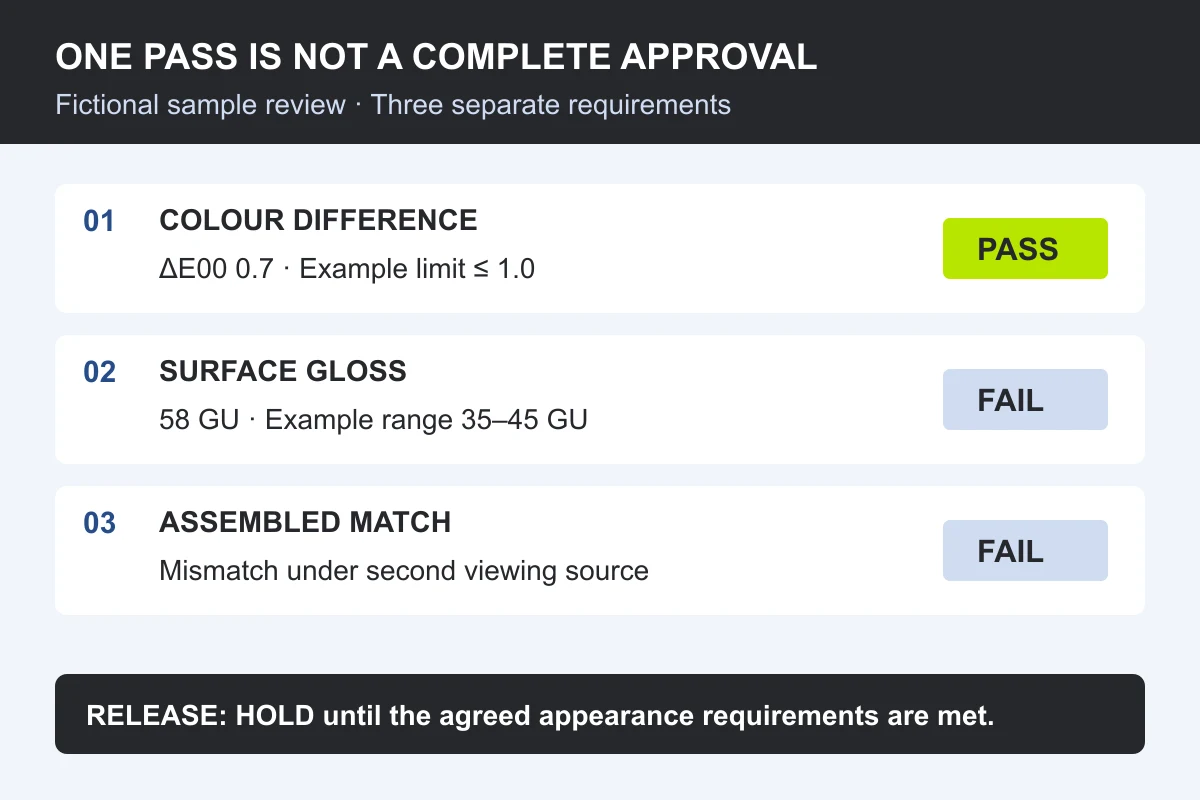
Words such as premium, clean, smooth, or close to the sample are not inspection criteria. Record the material and finish, then define which surfaces are customer-facing and what variation is acceptable. Review color under agreed lighting, logo position against a dimensioned drawing, gaps and alignment at assembly lines, surface texture, gloss, printed icons, fabric direction, wood pattern expectations, and visible marks.
For natural or variable materials, do not approve a single ideal piece and expect every unit to look identical. Create an approved range using boundary samples or signed photographs that show the lightest, darkest, or most visible acceptable variation. Define viewing distance, lighting, and whether small marks on hidden surfaces are treated differently from marks on the top of the base or lamp head.
4. Verify Mechanical Construction and User Interaction
Operate the sample as a customer would. Place it on a flat surface, adjust every joint, fold and unfold it, rotate the head where applicable, connect the adapter, route the cable, press every button, and check stability at the least favorable position. Record dimensions and weight rather than relying only on catalogue values.
- Base remains stable and does not rock on the agreed reference surface.
- Hinges move smoothly, hold the intended position, and do not expose pinching or sharp-edge concerns.
- Buttons, sliders, and touch controls respond consistently and match the approved control sequence.
- Cable entry, strain relief, connectors, screws, covers, and adapter fit match the approved construction.
- Folding, rotating, or telescoping parts meet the buyer-defined cycle and looseness criteria.
- The packed lamp can be assembled or placed in service using the supplied instructions and tools.
IEC 60598-1:2024 is the current IEC general safety standard for luminaires and covers areas including marking, mechanical and electrical construction, and photobiological safety. Golden-sample review can confirm the chosen configuration, but it does not replace testing to the standards and regulations applicable to the target market.
5. Freeze the Lighting Performance and Control Logic
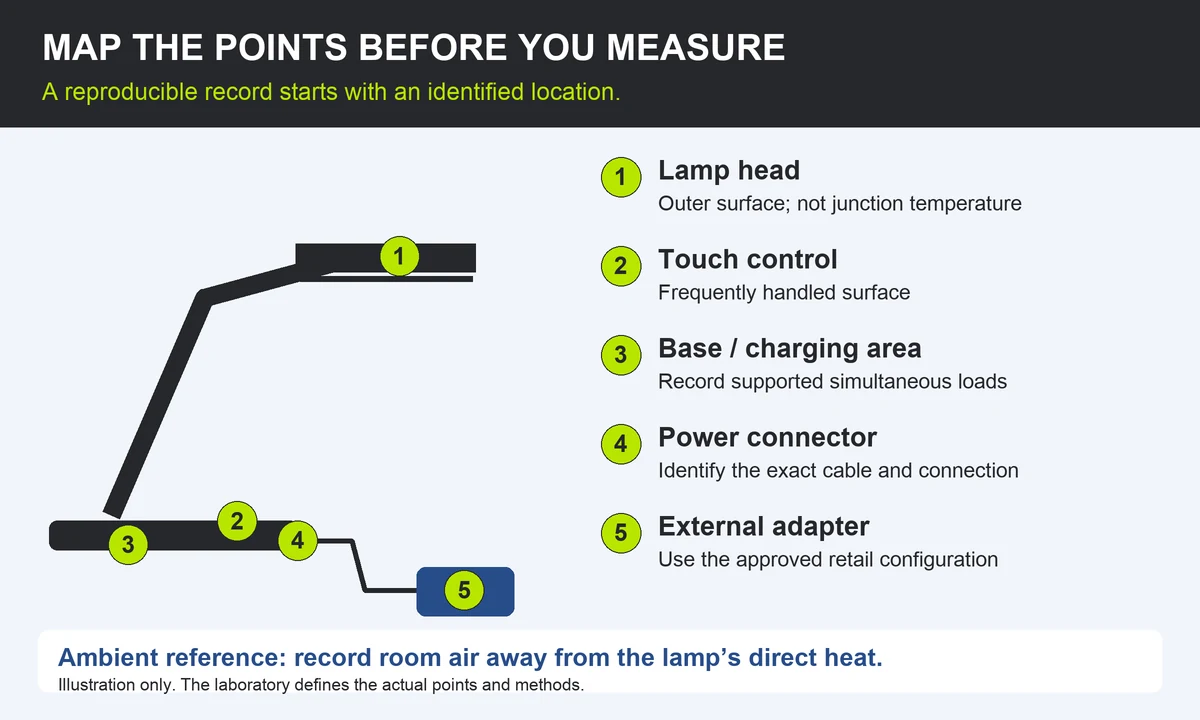
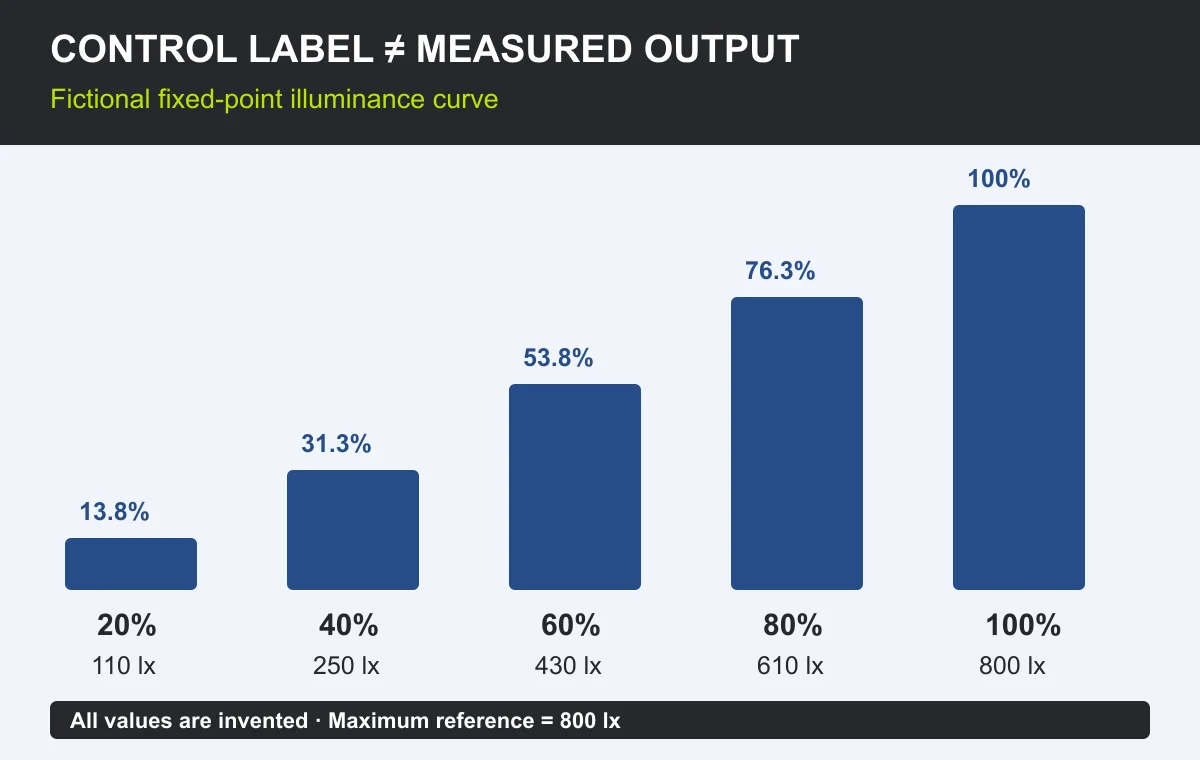
Two lamps can look identical while producing different light because of changes to the LEDs, diffuser, driver, optics, firmware, or power supply. Approve lighting performance with a repeatable setup. Record input power arrangement, lamp geometry, warm-up time, ambient condition, measurement distance and points, meter used, and tolerance.
| Lighting characteristic | Approval evidence | Why it matters |
|---|---|---|
| Brightness | Illuminance at fixed points and agreed lamp position | Prevents subjective bright-enough decisions |
| Color modes | Mode sequence and measured or specified color temperature range | Prevents wrong order and visible unit-to-unit mismatch |
| Dimming | Number of steps or slider behavior, minimum level and transition | Reveals dead zones, jumps, reset, or unstable control |
| Distribution | Measurement grid or approved illuminated-area comparison | Controls hot spots and poor task coverage |
| Flicker and noise | Buyer-defined test method and operating conditions | Avoids relying on a phone-camera demonstration alone |
| Memory and timer | Startup, power interruption, memory and timer sequence | Confirms firmware behavior before production |
Use the same evidence when comparing suppliers. The guide on comparing LED desk lamp specifications explains why nominal wattage or lumen claims alone do not create an equivalent product.
6. Test Wireless and Wired Charging as a Complete System
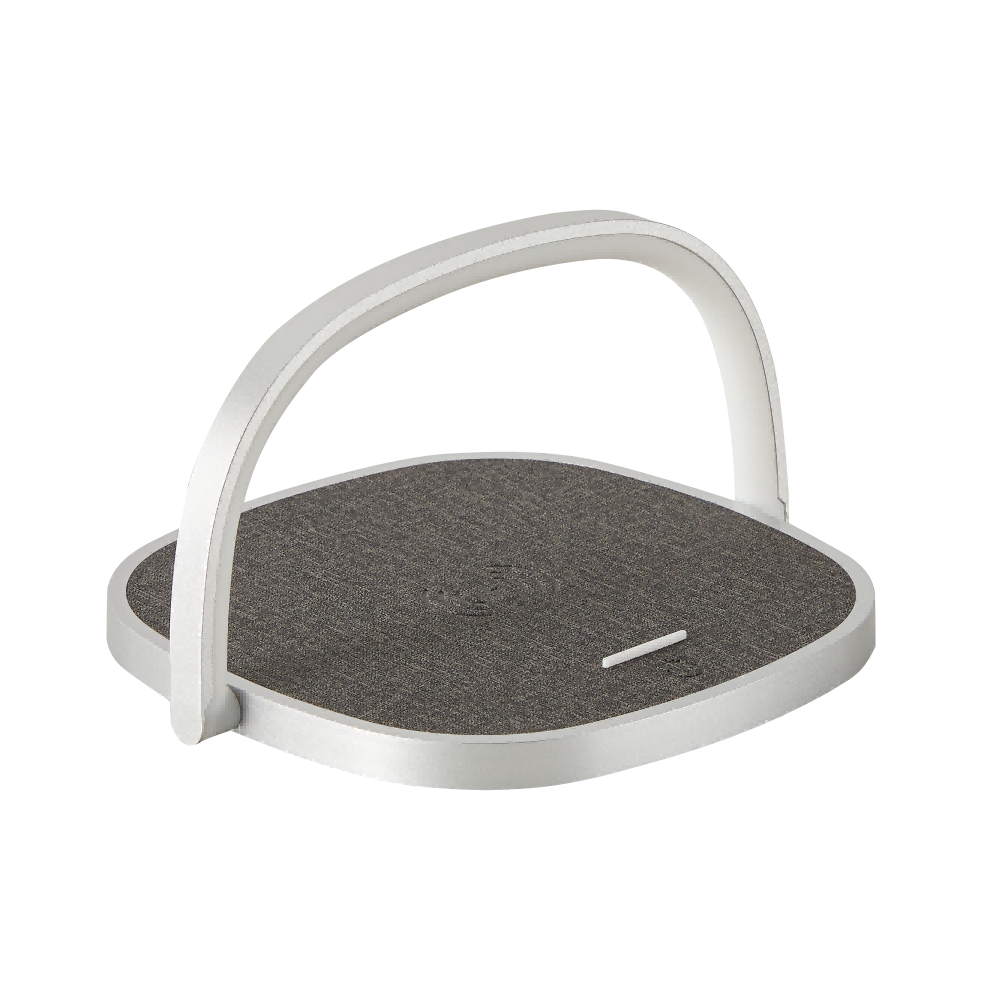
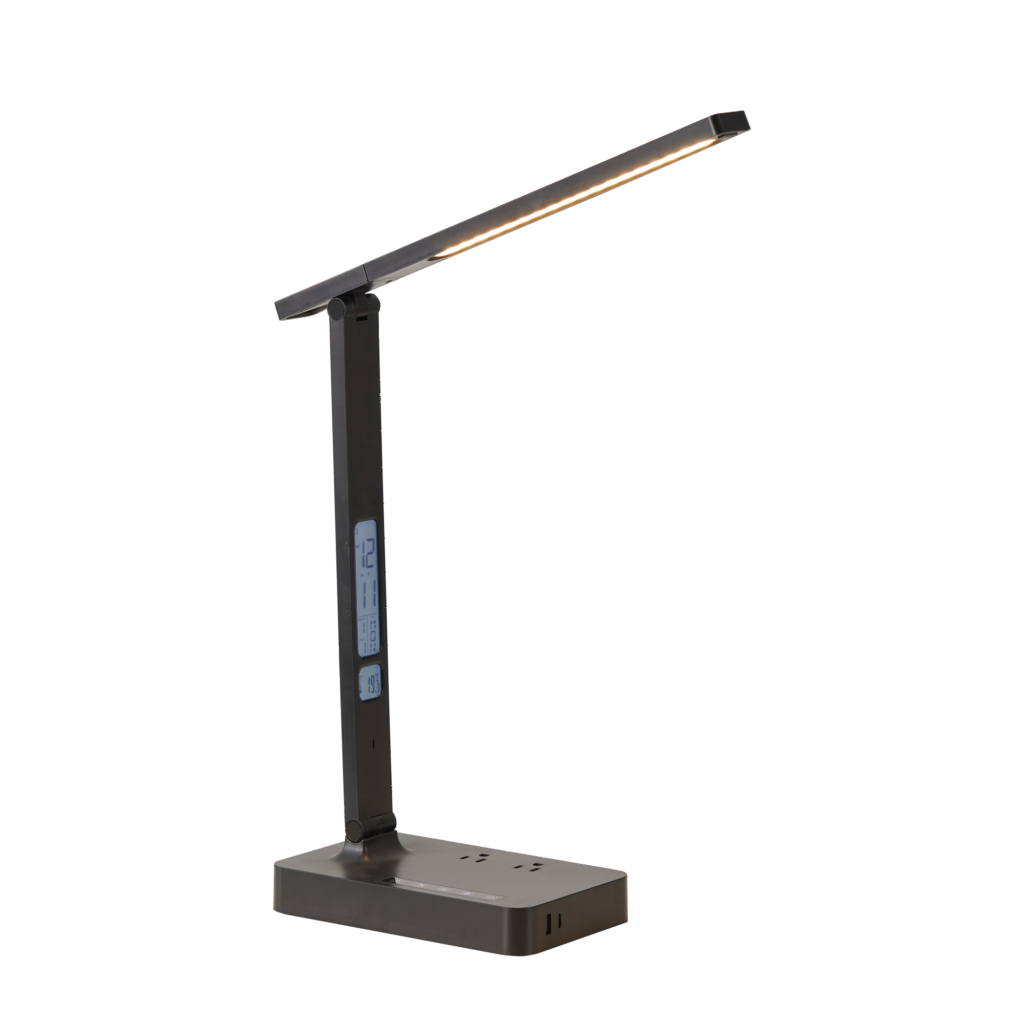
For multifunctional lamps, approve the complete power system rather than the charging module in isolation. Identify the exact adapter and cable, input rating, wireless output claim, wired USB or Type-C outputs, test phones, permitted case conditions, alignment area, operating time, and simultaneous-use scenario.
- Confirm that charging starts and remains stable for the agreed period with the specified adapter.
- Check practical phone positions and representative devices instead of testing one carefully centered phone.
- Operate the lamp, wireless charging, display, and wired outputs together where simultaneous use is intended.
- Record repeated reconnecting, abnormal heat, noise, odor, shutdown, or control interference.
- Confirm what happens after input power is removed and restored.
If a product is claimed as Qi Certified, verify the exact finished product in the Wireless Power Consortium certified product database. WPC also explains that using components from another certified product does not automatically make the finished product compliant because housing materials, coil position, shielding, firmware, and power conditions can affect wireless power transfer.
For U.S. projects, consult the FCC's current wireless power transfer equipment authorization guidance for the exact design and operating mode. The wireless charging desk lamp RFQ checklist can help buyers define these inputs before the sample is built.
7. Review Labels, Instructions, and Market Documents Together
Compare the physical sample, adapter, retail box, manual, test reports, declaration, and product listing as one information set. Model number, electrical ratings, responsible-party details, plug, warnings, functions, charging claims, conformity marks, and recycling information must not contradict one another.
The European Union's official CE marking guidance explains that manufacturers must identify applicable requirements, assemble technical evidence, and sign an EU Declaration of Conformity before affixing CE marking where required. The exact obligations depend on the product and market; there is no central EU office that simply issues a general CE certificate.
For Great Britain, the official Electrical Equipment (Safety) Regulations guidance describes manufacturer and importer duties, including technical documentation, conformity procedures, declarations, traceability, and product information. Buyers should have a qualified compliance specialist confirm which rules apply to the exact desk lamp, adapter, charging functions, voltage range, and route to market.
8. Approve the Product in Final Packaging
A loose engineering sample is not a finished retail product. Repeat the review with the approved adapter, cable, manual, accessories, protective bags, inserts, retail box, barcode, carton marks, and master carton. Confirm that parts cannot rub against the lamp finish, the head and hinges are restrained, heavy adapters cannot strike the product, and the customer can repack or assemble the lamp as intended.
- Photograph the exact packing sequence and orientation.
- Record retail box and master-carton dimensions, weights, materials, and revision.
- Verify barcode content and scanning, not just graphic appearance.
- Check manual language, accessory count, spare parts, and destination plug.
- Define transport test method and acceptable product and packaging damage before testing.
9. Sign an Approval Sheet with Conditions and Open Items
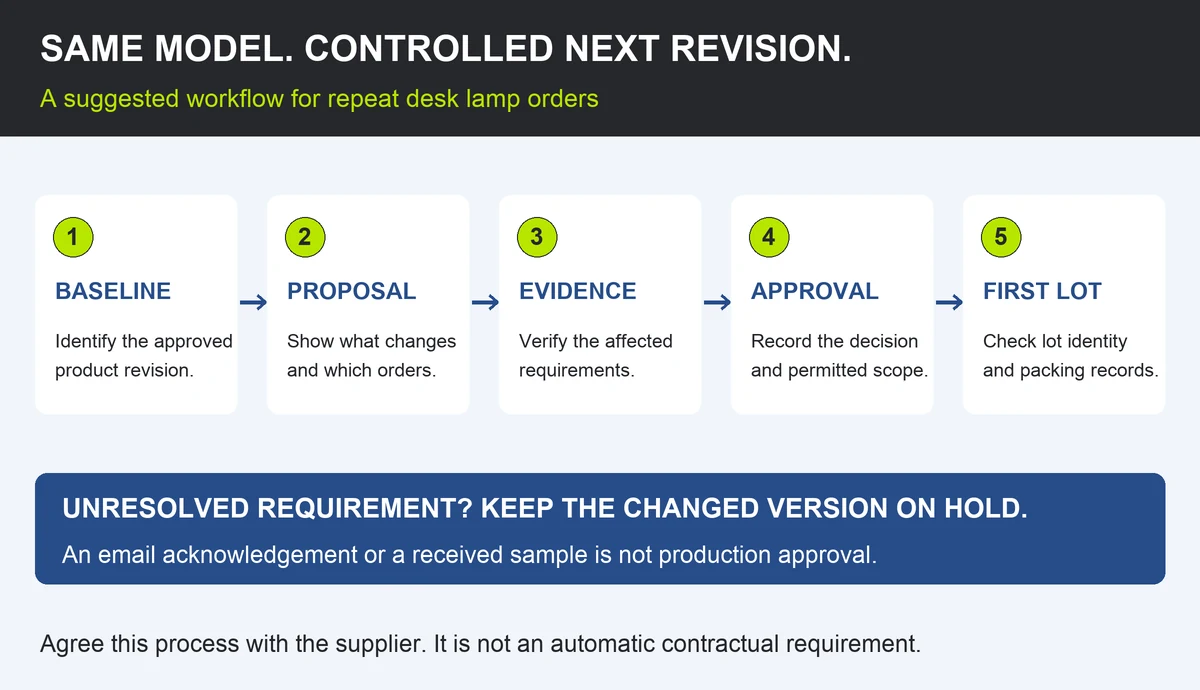
Do not let a casual email saying sample looks good become the only production authorization. Use an approval sheet that lists every referenced file and sample ID, the approved result, conditional items, unresolved items, responsible person, deadline, and whether mass production may begin.
| Status | Meaning | Production action |
|---|---|---|
| Approved | Configuration and referenced evidence meet the agreed requirements | Release only the identified revision |
| Approved with conditions | Specific corrections are accepted without another complete sample | Close every condition with written evidence before the defined gate |
| Revise and resubmit | Changes affect appearance, function, construction, documentation, or risk | Do not treat the current sample as the production standard |
| Rejected | The proposed configuration does not meet the requirement | Stop release and agree a corrective development plan |
10. Control Changes After Approval
The golden sample loses value if parts can change without review. Require written notification before changing the LED package, PCB, driver, adapter, wireless charging module, firmware, diffuser, plastic resin, metal thickness, hinge, finish process, adhesive, cable, label, manual, insert, or carton. The notification should explain the reason, old and new part, affected lots, risk assessment, and proposed validation.
Reapproval should be proportional to the change, not automatic paperwork. A cosmetic logo adjustment may require appearance and artwork checks; a driver or charging-module change can affect electrical performance, EMC, heat, compatibility, documentation, and applicable compliance evidence. Keep an approved deviations log and make sure the pre-shipment inspection checklist uses the latest authorized revision.
Copy-Ready Golden Sample Approval Checklist
- Product, color, electrical configuration, destination market, sample ID, and revision are identified.
- Approved specification, drawings, component list, artwork, labels, manual, and packaging files are attached.
- Dimensions, weight, materials, finish, color range, logo, gaps, alignment, and cosmetic boundaries are recorded.
- Stability, hinges, moving parts, cable entry, controls, assembly, and accessories are checked.
- Lighting modes, dimming, illuminance setup, color sequence, distribution, memory, timer, noise, and heat criteria are agreed.
- Adapter, wireless and wired charging, device compatibility, simultaneous operation, and abnormal behavior are tested.
- Market claims and compliance documents match the exact model and configuration.
- Final retail and master packaging, barcodes, carton marks, manuals, inserts, and packing sequence are approved.
- Open items, conditions, responsibilities, production-release status, and change-notification rules are signed.
- Matching controlled samples or sealed records are retained by buyer and supplier.
Final Takeaway
A useful golden sample is not merely the nicest lamp produced during development. It is an evidence-linked production standard. When the sample, specification, measurements, artwork, packaging, documents, and revision status all agree, the factory has a reproducible target and the buyer has a defensible basis for inspection and change control.
Explore RoyeLamp's LED desk lamp range, including the RY26 foldable desk lamp, RY29 wireless charging model, and RY2309-P power-integrated model. For an OEM, private label, or wholesale project, send RoyeLamp your target market, functions, quantity, branding, and approval requirements so the sample plan can be defined before production.
Frequently Asked Questions
Is a golden sample the same as a certification sample?
No. A golden sample is the buyer-approved commercial reference for appearance, construction, function, accessories, labels, and packaging. Regulatory testing and certification follow the requirements of the destination market and exact product configuration.
How many approved samples should a buyer keep?
A practical arrangement is one sealed reference with the buyer and one controlled reference with the supplier, with matching sample IDs, revision records, photographs, and approval dates. The contract should define which record controls if the samples differ.
What should be reapproved after a component change?
Reapproval should cover every characteristic the change can affect. A driver, LED board, adapter, charging module, hinge, finish, housing material, firmware, label, or packaging change may require targeted performance, safety, compatibility, appearance, or transit checks.
Can mass production start before the golden sample is signed?
It can, but doing so transfers unresolved decisions into production and increases rework risk. Buyers should define the approval gate, allowed preliminary work, and responsibility for any material committed before written approval.
References
- IEC 60598-1:2024 - Luminaires: General requirements and tests
- Wireless Power Consortium - Certified Product Database
- Wireless Power Consortium - Qi components and subsystems
- FCC KDB 680106 - Wireless Power Transfer Equipment Authorization Guidance
- European Union - CE marking requirements
- GOV.UK - Electrical Equipment (Safety) Regulations 2016 guidance
Standards and market rules change. Confirm the current editions and legal requirements for the exact product, voltage, charging configuration, responsible party, and destination market before approval or sale.
