

A desk lamp can look convincing in a five-minute demonstration and behave differently after it has warmed up. For a bulk buyer, the useful question is not simply whether the housing feels warm. It is whether the approved configuration stays within its applicable temperature limits and delivers the agreed lighting and charging performance throughout normal use.
Approve a temperature record for an identified lamp, power supply, operating mode and environment—not a photograph labelled “heat test passed.” Keep safety compliance, component reliability and customer-facing performance as separate acceptance decisions.
This guide helps importers and private-label brands specify a thermal review before production. It is a procurement framework, not a laboratory procedure or a substitute for product safety testing.
1. Define what the thermal test must prove
“The lamp did not switch off” is a narrow observation. It does not establish that a frequently touched control is acceptable, that an internal component has adequate operating margin, or that the lamp maintains its advertised output.
| Decision | Evidence to request | What it does not establish |
|---|---|---|
| Product safety | Applicable test report, configuration identity, measurement points and limits selected for the product and destination market | A purchasing checklist cannot replace the required safety evaluation |
| Component suitability | Relevant component ratings, measured reference-point temperatures and the supplier’s engineering assessment | A cool outer cover does not prove that every internal part is cool |
| Usable performance | Lighting and charging behaviour throughout the agreed operating period and conditions | Compliance with a temperature limit does not automatically meet a brightness or charging promise |
IEC 60598-1:2024 sets general safety requirements and tests for luminaires. Its public description is not enough to choose a temperature limit for a particular lamp. Ask a competent laboratory to confirm the applicable product-specific requirements, edition and destination-market adoption for the exact configuration. Do not copy one temperature from an unrelated report.
Before samples are tested, agree which result leads to approval, engineering review or rejection. Record the acceptance source for each measurement point and how measurement uncertainty or a borderline result will be handled. A result with no stated limit is data, not a pass.
2. Test the configuration customers actually receive
A thermal report is only useful if it represents the ordered product. Record the model, sample serial number, LED board, driver or control revision, housing construction, adapter and cable. If the test uses a different power supply from the retail kit, ask for the justification or a repeat test with the approved supply.
Build the operating matrix around supported use. Do not assume the colour mode that looks brightest is necessarily the one with the highest electrical load. Ask the supplier to identify the relevant demanding modes and document why they were selected.
- Lighting alone: review the relevant brightness and colour modes, with the lamp positioned as instructed.
- Lighting plus charging: include simultaneous functions only where the product is designed and advertised to support them.
- Rechargeable models: record battery state and the charging stage, because the load can change during a run.
- Adjustable designs: evaluate the permitted positions that may change airflow or put warm surfaces close together.
- Ambient conditions: identify the intended operating range and the conditions the laboratory uses to assess it.
For wireless charging, identify the receiving device or test load, alignment and case configuration. For wired charging, identify the load and negotiated mode where relevant. A report saying only “phone connected” is difficult to reproduce. The wireless charging RFQ checklist covers the wider compatibility specification; this thermal review asks what happens while the selected functions operate together.
Do not improvise by blocking ventilation, bypassing protection, fitting an incorrect adapter or opening an energized lamp. Formal abnormal-operation tests need controlled procedures and qualified personnel.
3. Use a measurement map, not one “lamp temperature”
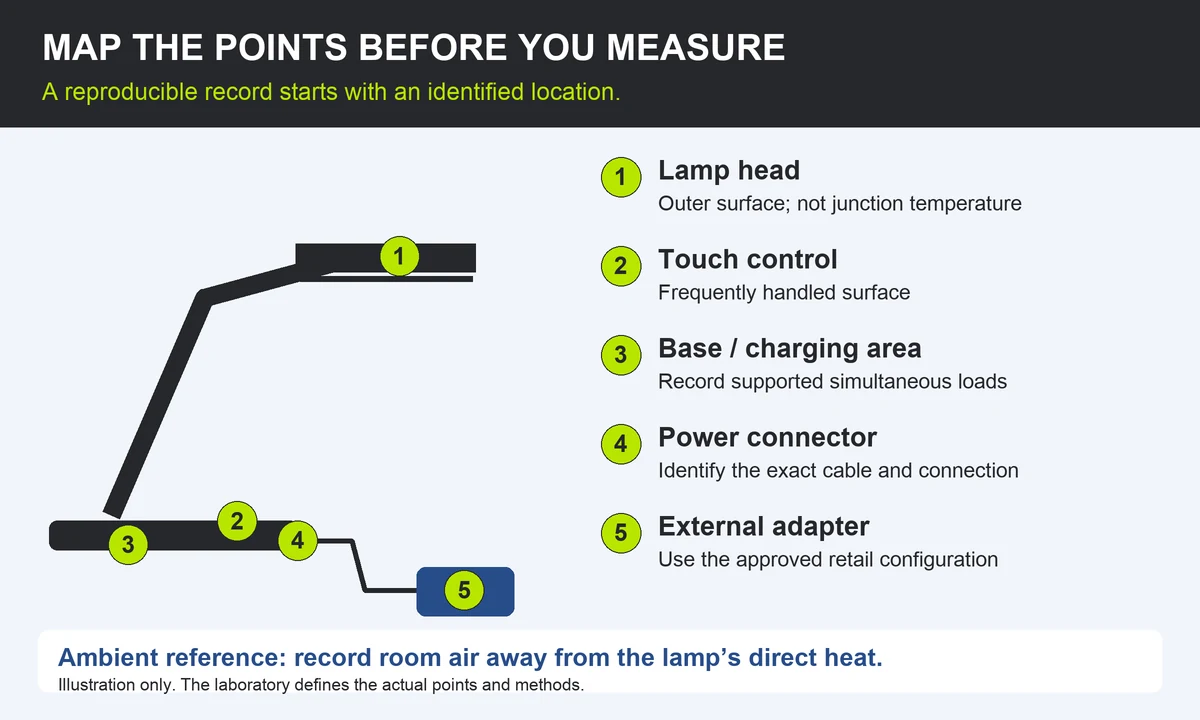
A measurement point needs a name, location and purpose. Request a photograph or drawing that another inspector can use to find the same point. For a typical desk-lamp review, the map may include the lamp head, a frequently touched control, the base, the connector area and the external adapter. Internal points should be chosen and measured by qualified personnel.

Surface temperature is not LED junction temperature. The LED junction is inside the semiconductor package. A reading on the lamp head, LED board or component case represents a different location. The U.S. Department of Energy’s thermal-management primer explains the roles of drive current, heat flow and ambient temperature. It is useful background physics; its older component examples are not specifications for current RoyeLamp products.
Ask the supplier to explain any relationship between a measured point and a component rating. Do not accept a housing reading relabelled as junction temperature without a documented method. Likewise, a short temperature run cannot substantiate a claim of tens of thousands of operating hours.
Why a thermal image needs supporting measurement details
An infrared image can help locate areas to investigate, but its apparent temperatures depend on the surface and instrument settings. Fluke’s emissivity guidance explains why shiny bare metal and coated surfaces can produce different readings even at similar actual temperatures.
Request the emissivity and reflected-temperature settings, measurement location and any contact-sensor cross-check used for critical points. For contact measurements, record the probe attachment method. The laboratory should ensure that sensor placement or surface preparation does not materially change the behaviour being measured. Do not use an unexplained thermal-camera screenshot as the entire acceptance record.
4. Read absolute temperature and temperature rise together
A temperature without an ambient reading is incomplete. Record the air temperature at an agreed reference location, away from direct influence of the lamp’s heat, throughout the run. Report both the measured point temperature and its rise above the corresponding ambient reading:
The following independent, fictional readings show why both values matter. They are not RoyeLamp measurements, acceptance limits or a prediction that the same lamp always maintains a fixed rise.

Use each limit as it is defined in the applicable method. Do not replace an absolute-temperature limit with a rise limit, or extrapolate a room-temperature result to a warmer environment without engineering justification. The two fictional readings also cannot rank two designs unless their construction, loading and measurement conditions are comparable.
This is especially useful when comparing supplier reports produced in different rooms or seasons. Ask for the raw ambient and point readings before concluding that the lower reported housing temperature represents the better design.
5. Track output while the lamp reaches thermal stability
Specify the logging interval and the method’s thermal-stability criterion before testing begins. An elapsed time by itself does not establish stability. Different points can settle at different rates, and a changing charging load can make one endpoint misleading. Keep the temperature-versus-time record and explain any load changes.
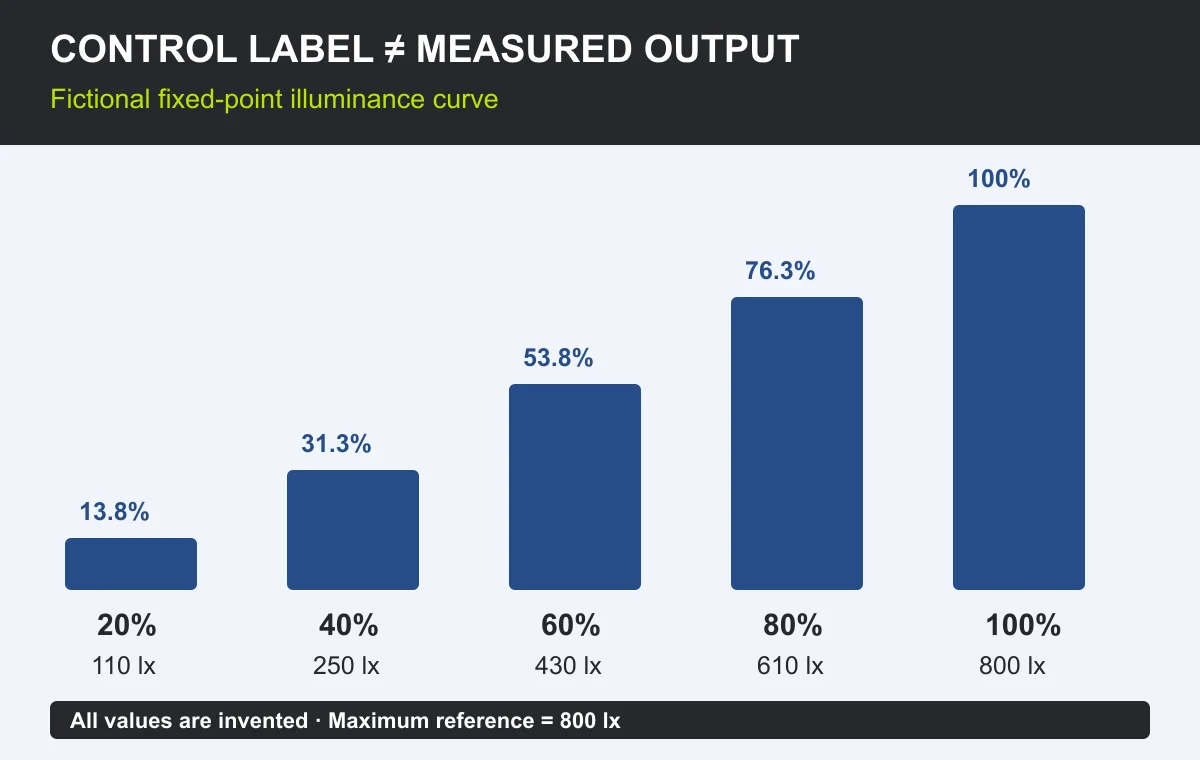
Alongside temperature, record lighting performance using fixed geometry, the same control setting and controlled ambient light. A fixed-point illuminance reading can reveal changes during the run; it does not measure total lumen output. The illuminance coverage guide explains why measurement position matters.
For example, if an agreed reference reading is 800 lx and a later reading is 736 lx, the change is (736 − 800) ÷ 800 × 100 = −8%. These numbers are invented to explain the calculation. An 8% decrease is neither a universal failure threshold nor proof of permanent LED degradation. Confirm the test setup, supply behaviour and any control response before assigning a cause.
If a controller reduces lighting output or charging power, the final temperature may look satisfactory while the customer receives less performance than expected. Record temperatures and operating behaviour together, including any reduction, shutdown, cycling and recovery.
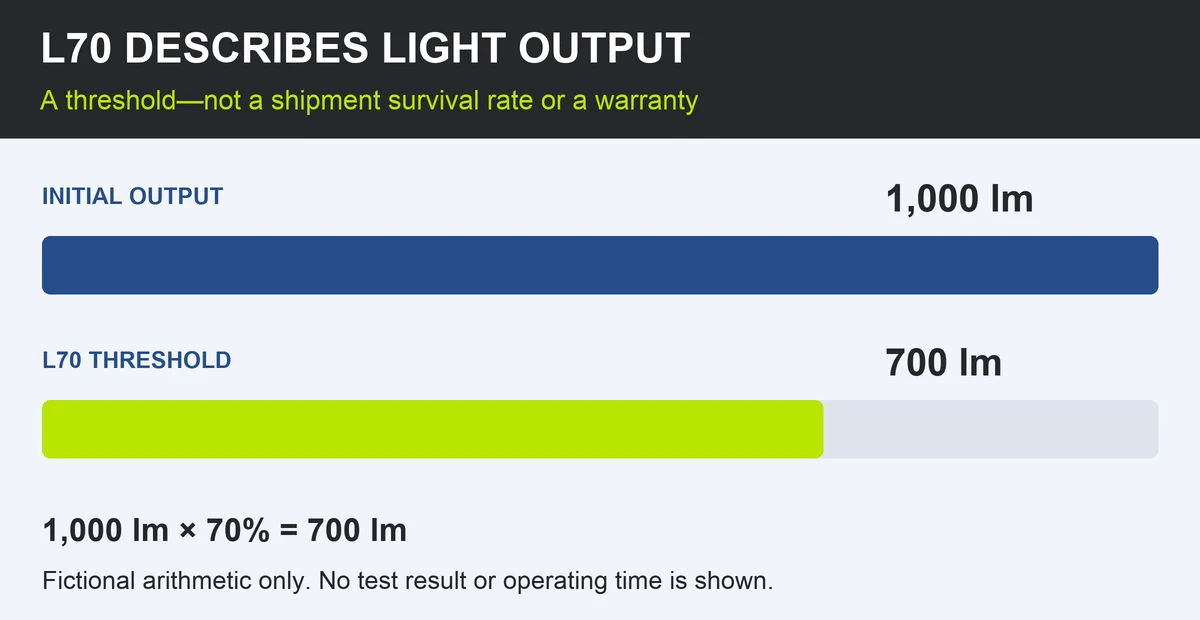
If output changes during warm-up, ask whether it settles within the agreed performance range, whether a protective function was active, and what happens after cooling and restarting. Keep short-term behaviour separate from long-term lumen-maintenance claims. For rechargeable lamps, use the battery procurement guide for cell identity, charging and supporting battery evidence.
6. Turn the report into a clear release decision
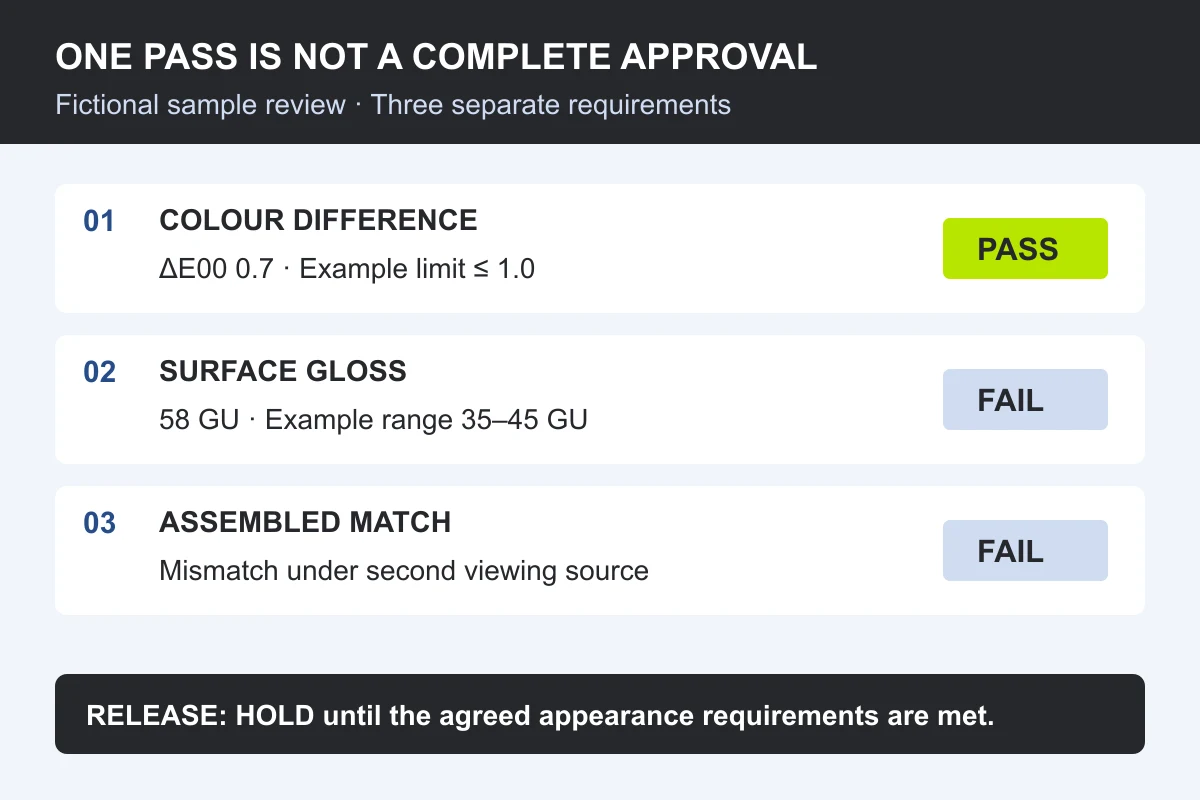
The report should let a buyer trace each conclusion back to a sample and a defined requirement. A one-line “passed” certificate without configuration identity or measurement details leaves the central purchasing question unresolved.
| Required record | Review question | If missing |
|---|---|---|
| Sample and configuration identity | Does the tested adapter, board revision, housing and cable match the order? | Resolve equivalence or repeat the affected tests |
| Operating matrix and environment | Were supported simultaneous functions and relevant modes covered? | Request the missing conditions or an engineering rationale |
| Point map and measurement method | Can the critical readings be reproduced and interpreted? | Clarify locations, instruments, settings and uncertainty |
| Time records and stability evidence | Do the records cover warm-up and any changes in loading? | Keep the result provisional |
| Limits and performance results | Is each acceptance decision tied to a stated requirement? | Do not convert observations into an unconditional pass |
| Deviations and change control | Are open issues closed before the configuration is released? | Hold approval of the affected configuration pending review |
Retain the approved record with the golden sample. Changes to the LED board, drive settings, thermal interface, enclosure, adapter or charging hardware should trigger a documented review of whether targeted retesting is needed. A matching model name alone does not establish thermal equivalence.
At pre-shipment inspection, verify the approved configuration and the agreed production checks. A short functional check cannot replace the qualification run. Agree the sample quantity, lot traceability, escalation process and responsibility for closing a deviation before shipment.
Copy this request into your supplier brief
Please provide a thermal evaluation plan for the selected desk-lamp configuration. Identify the lamp, LED board, driver/control revision, enclosure, adapter, cable and any charging hardware. Include the proposed operating matrix, ambient conditions, measurement-point map, instrument methods, logging interval, stability criterion and sample quantity. State the applicable acceptance source and limit for every critical point, and record lighting/charging performance during the run. Identify protective behaviour, deviations, corrective actions and component changes that require review before production approval.
Questions buyers often ask
Is a warm metal lamp head automatically a defect?
No. It may be part of the intended heat-transfer path. Warmth alone proves neither good thermal design nor a safety problem. Review the actual measurement point, applicable limit, internal component evidence and usable performance.
How many hours should a desk-lamp thermal test run?
There is no single duration that proves every design. Use the applicable method and an agreed stability criterion, with enough coverage to capture relevant operating states. A battery charging cycle may require review beyond one steady operating point.
Does a passed temperature test prove the advertised service life?
No. It describes the tested conditions and requirements. Lifetime claims need separate evidence covering relevant components, operating conditions and the complete product.
Technical scope: The linked IEC page establishes the standard’s general scope, not product-specific pass/fail limits. The DOE primer supports thermal principles, not current product lifetime claims. Fluke supports the infrared-measurement caution. All numerical examples and diagrams in this guide are illustrative.
