

A magnifying desk lamp earns its place in a wholesale range when customers can see the detail they need and still have room to work. For craft retailers, repair-tool distributors and private-label buyers, that makes the lens, lamp position and complete power set central to the buying decision.
This guide uses RoyeLamp’s RY01 as a starting point for a sample enquiry. It explains how to turn a general request for a “magnifier lamp” into a configuration you can demonstrate, quote and approve for a bulk order.
Define the smallest detail the customer needs to see, the area they need in view and the space their hands or tools require. Then test a complete lamp sample against that task. Confirm the lens specification, power components, packaging and order terms in the same approval record.
Start with the customer’s task and sales channel
A sewing-accessory retailer and an electronics-tool distributor may both sell magnifying lamps, but their demonstrations and support questions differ. Describe one primary use for the first order. A focused brief gives the supplier something concrete to assess and gives your sales team a repeatable way to explain the product.
| Buyer’s intended range | Bring to the sample review | Approval question |
|---|---|---|
| Craft and sewing accessories | Typical fabric, thread, beads or small components, plus the tools used with them | Can the user keep the relevant detail in view while manipulating the material? |
| Repair and hobby tools | A representative unpowered workpiece, task tools and the normal work mat | Does the viewing position leave enough clearance for the intended hand movements? |
| Reading and collector supplies | The print size, labels or objects customers intend to inspect | How much of the subject stays clear at the preferred viewing position? |
| Private-label specialty retail | A proposed product listing, carton layout and intended customer demonstration | Can every advertised feature be reproduced on the approved configuration? |
For specialist work, add the applicable requirements to the enquiry at the outset. An electronics workstation may have a documented electrostatic-discharge control requirement. A colour-assessment task may require measured colour-rendering data. These requirements need model-specific evidence before the lamp is approved for that application.
Where RY01 fits in a wholesale shortlist
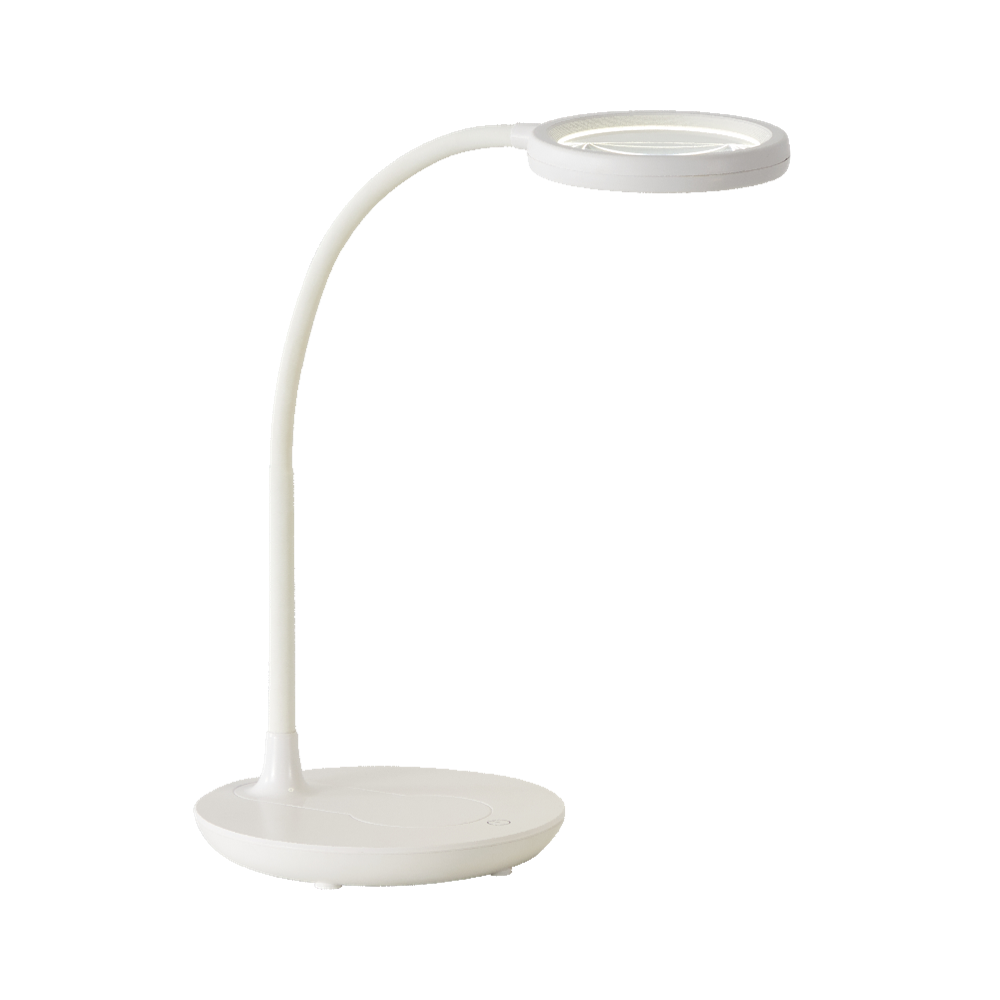
A compact magnifier and task light for detailed work
RY01 combines a built-in magnifying lens, a flexible neck and a freestanding base. This format is a useful sample candidate for retailers seeking a compact light that customers can position beside a small work area.
The current product specification lists 5W, 250 lm, 4000K and 5V / 1A input, with a white ABS and silicone body. The integrated light and lens can be evaluated together in one countertop demonstration.
For a first enquiry, send RoyeLamp a photograph of the intended task and the approximate space available. Ask for the lens diameter, usable viewing area, magnification and working-distance information for the proposed sample. The current RY01 page leaves the numerical magnification specification for confirmation, so make that a written quotation item.
Logo, colour, packaging and manual options can be discussed for an OEM or private-label programme, subject to model and order review. Request an unbranded sample for the functional review, then approve the branded configuration and packaging when those details are agreed.
Ask about a paid RY01 sample for your target application →
Compare magnification, viewing area and working space together
Three questions belong on the same sample sheet. How much detail can the user resolve? How much of the workpiece stays visible? How much space remains between the lens and the workpiece for tools?
Identify the feature the user must see clearly.
Check the portion of the task visible in one position.
Rehearse the hand movements at that viewing distance.
Working distance is the gap between the magnifier and the object being viewed. Eye relief concerns the viewing distance on the other side of the lens. Optical selection involves trade-offs between magnification, viewing area and comfortable positioning. Edmund Optics explains these relationships in its guide to choosing a magnifier. Read the optical selection reference.
In practical terms, ask the supplier to identify how a stated magnification value is specified. If one quotation uses dioptres and another uses an “X” figure, request a comparable lens description and viewing setup. Keep the written specification alongside observations from the sample.
Try a flat printed grid and your actual workpiece. Look at the centre and the area you expect to use near the edge. Record visible distortion, changes in focus and any position that makes the task difficult. A grid provides a consistent comparison target, while the workpiece establishes whether the sample suits your intended customer.
Run a sample review your team can repeat
Use the same desk, chair, room lighting, power components and workpiece when comparing samples. Keep photographs of the setup so another colleague can reproduce the review. The following sequence produces a useful buying record without turning the discussion into a list of unrelated specifications.
- Unpack the complete saleable set. List the lamp, cable, power supply if included, instructions and protective inserts. Record the model and any identifying marks on the power components.
- Position the lens for the actual task. Adjust the neck until the subject is clear. Check that the base fits beside the workpiece and that the user can reach tools without moving the lamp each time.
- Check the view with the light on. Look for reflections from glossy labels, polished parts or clear packaging. Try the normal hand positions and note where fingers or tools interrupt the view.
- Observe position retention. Leave the head in the intended working position for an agreed observation period. Record any drift, rebound or base movement. Repeat representative adjustments and check the position again.
- Review controls and power connection. Have someone unfamiliar with the sample switch it on, adjust its position and reconnect it. Capture any explanation required for a customer instruction sheet.
- Repack and inspect. Check how the lens, light head and neck are supported in the proposed pack. Photograph contact points and any marks after unpacking again.
Define acceptance criteria before the order. “Head remains in the approved task position throughout the agreed observation period” is more useful than “good quality.” Specify the test position, observation time and allowable movement with the supplier. Sample-screening observations help select a configuration, while production inspection needs an agreed method and sampling plan.
For a shared approval record, use our golden-sample approval checklist to capture the final lamp, accessories, labels and packaging together.
Quote the complete power and packaging configuration
RY01’s listed input is 5V / 1A. Ask which cable and external power supply are included in the quoted set, and confirm the connection type, cable length and destination-market requirements. A distributor can then show customers exactly what arrives in the box and what they need to operate it.
Packaging deserves particular attention around the optical head. Ask for a pack that supports the lamp and protects the lens surface during the agreed distribution route. Review the actual insert and packed sample, including the space between the lens and accessories. For parcel fulfilment, have the outer shipping pack reviewed as part of the same configuration.
Include the manual language, model label, barcode location, logo artwork and carton marks in the quotation. Agree a handling and cleaning instruction suitable for the approved lens and body materials. Where service parts or replacement units are offered, document how your team identifies the correct version.
Ask each supplier to price the same lamp configuration, complete power set, individual packaging, branding and shipping basis. List sample charges, artwork or setup charges and any additional test costs separately. This makes the first order and a later replenishment easier to compare.
Build a trial order around what you need to learn
A first order can validate a specific retail proposition. Choose the customer task, demonstration method, intended selling channel and approved configuration before adding several finishes or lens options. Each additional configuration needs its own clear identification and approval.
For example, a craft distributor could trial one approved white RY01 configuration with selected stockists and reserve units for demonstrations and service. Decide in advance which feedback to collect, such as lens positioning questions, requests for an adapter, packaging damage and the tasks customers actually attempt. Set the replenishment decision against your own sales and service expectations.
Ask RoyeLamp to confirm MOQ by configuration, sample availability, production timing and shipping terms in writing. Build the launch calendar around sample approval, artwork approval, production, transit and receiving checks. Product changes agreed during sampling should also appear in the final order record.
Send a brief that can produce a usable quotation
The fastest useful enquiry gives the supplier the task, destination and proposed order scope. You can copy the following brief and replace the brackets.
RY01 wholesale enquiry brief
We are sourcing magnifying desk lamps for [craft retail / repair-tool distribution / collector supplies / other use] in [country]. Please review RY01 for the attached task photograph.
- Estimated first order of [quantity], with [unbranded / logo / packaging] requirements.
- The smallest detail to view is [description]. The working area and tools are [dimensions or photos].
- Please confirm lens magnification, diameter, working distance and the proposed sample configuration.
- Please identify the included cable, power supply, instructions and individual packaging.
- Please quote paid samples, configuration-specific MOQ, setup costs, production timing and delivery terms to [destination].
- Our team requires [model-specific documents] and an on-site delivery target of [date].
Questions buyers ask before ordering
What magnification does RY01 provide?
Request the numerical lens specification for the configuration being quoted. RoyeLamp’s current RY01 page asks buyers to confirm magnification details and discuss available options. Include the agreed specification in the sample record and product listing.
Can we use RY01 for craft or repair-tool retail?
It is a sample candidate for close-up work where its lens, flexible-neck arrangement and base suit the task. Use representative materials and tools to approve viewing clarity, working space and stability. Add any specialist workstation requirements to the enquiry.
Can we order a branded version?
The product page offers OEM and private-label enquiries, with logo, colour, packaging and manual options subject to review. Confirm the available process, artwork position, MOQ and sample approval steps for your order.
How should we demonstrate it in a showroom?
Use the same kind of object approved during sampling, with the lamp at a documented working position. Show the viewing area, controls and complete power arrangement. Give staff a short demonstration card based on the approved sample.
Shortlist RY01 for your next buying programme
Send RoyeLamp your task photograph, estimated quantity and destination country. We can review the proposed application and confirm the lens configuration, paid-sample options and quotation details.
Written by Helen. RY01 information checked against the linked product page on November 15, 2026. Final specifications and commercial terms follow the approved sample and written quotation.
