

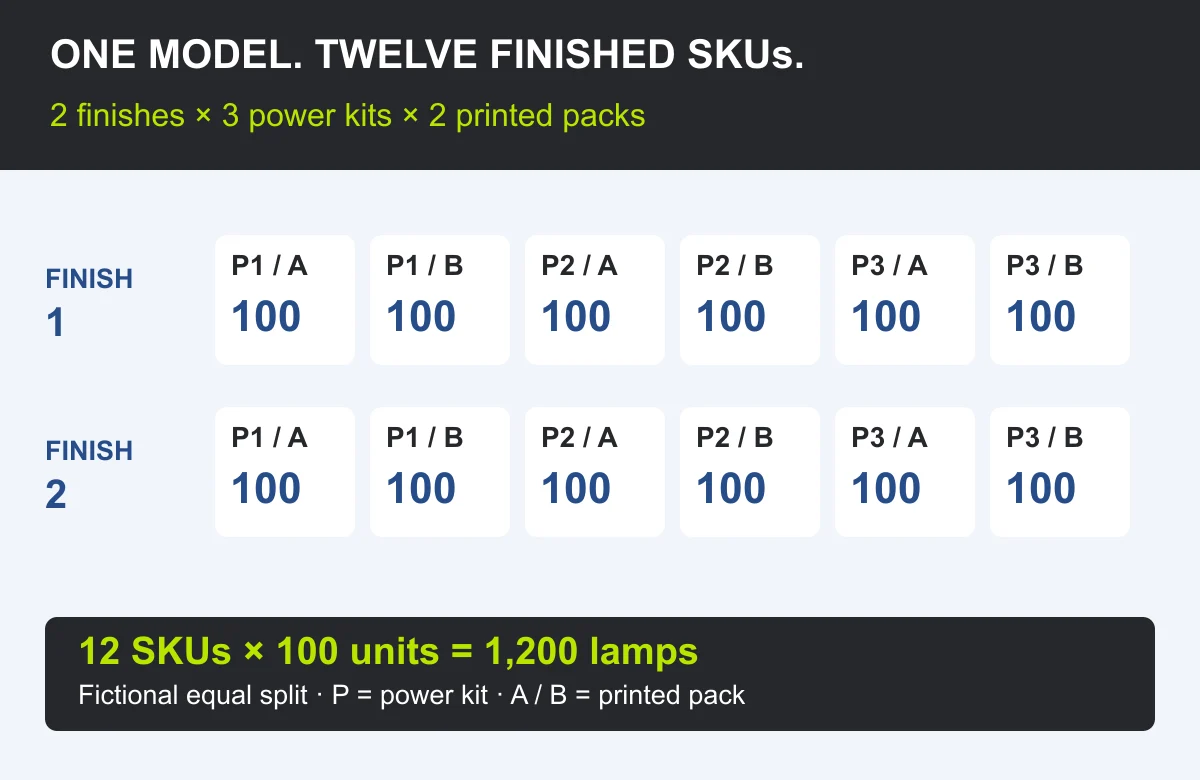
Your purchase order says 1,200 desk lamps. The range plan says two finishes, three power kits, and two printed-pack versions. If you order every combination equally, you are buying 100 units of each of 12 configurations. Which quantity does the supplier's minimum order quantity actually apply to?
That question belongs before the price negotiation. A model-level total can hide a shortage in a particular finish, adapter, or printed box. It can also hide an opportunity: shared components may support several finished configurations, if the supplier agrees to count them together.
The numerical example below is fictional. It explains order planning, not RoyeLamp's quoted minimums, available combinations, or production policy.
1. Separate the lamp model from the sellable configuration
A model identifies a product platform. For this guide, a finished SKU identifies the version your warehouse must pick: the specified lamp, finish, power kit, accessories, and packaging. The distinction matters when two cartons carry the same model name but contain different adapters or instructions.
Use a short internal code for each version that must be ordered or handled separately. Shopify's SKU guidance describes SKUs as internal inventory codes and recommends unique identifiers for distinct variants. You do not need to use Shopify to apply that operational principle.
Start with the combinations you actually intend to sell. Two finishes, three power kits, and two printed packs create 12 possible configurations only if every combination is valid and included. If a pack is approved for only one market or a power kit is unavailable for a finish, remove that combination rather than letting a spreadsheet generate it automatically.

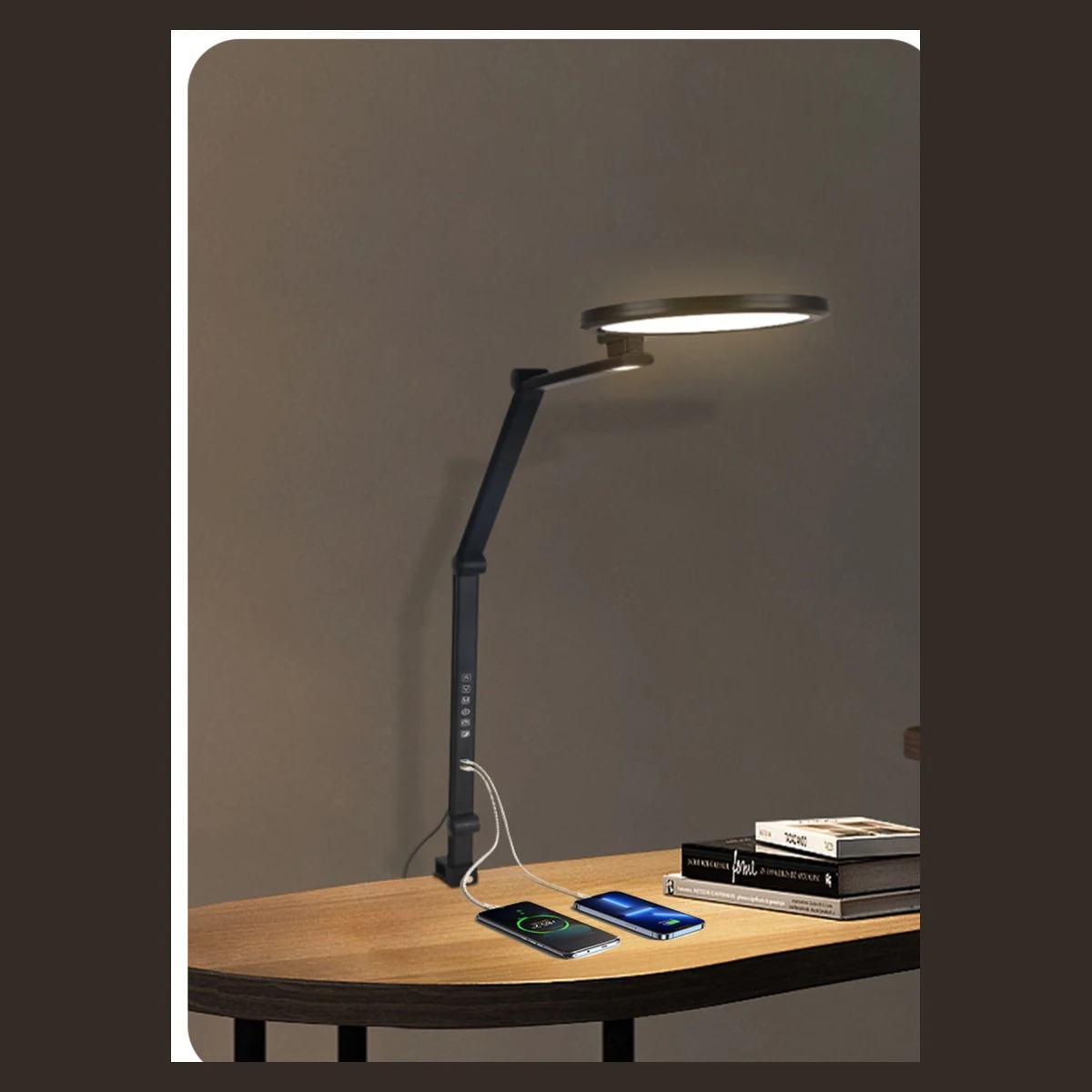
For example, the RY229-B product page lists black and white. That is a starting point for an availability enquiry, not evidence that every adapter, logo, and packaging combination is stocked. Ask which versions can be supplied before allocating quantities.
Give each power kit an exact adapter and cable reference. A plug shape alone does not define a compatible kit. Use the desk lamp power-configuration guide to identify the electrical package; this article focuses on how its quantities enter the order.
2. Check the same order at each level where a minimum applies
Consider a fictional 1,200-unit launch, evenly divided across all 12 configurations. The buyer asks two suppliers to explain their minimums. Their answers describe different production arrangements, even though both quotations name the same total quantity.
Arrangement A: the minimum applies to every finished SKU
If the confirmed minimum is 200 units for each finished SKU, 100 per SKU does not qualify. Keeping all 12 versions would require at least 12 × 200 = 2,400 finished lamps. That is 1,200 more than the launch plan. A lower unit price at that volume does not make the additional stock necessary.
Alternatively, suppose the supplier expressly allows the same lamp assembly to be split into the approved power-kit and packaging versions. The fictional minimums below are independent group requirements, with no additional finished-SKU minimum. Each finished unit uses one lamp assembly, one power kit, and one printed pack.
On a small screen, swipe the table sideways to see all columns.
| What the minimum applies to | Quantity in this order, per group | Fictional minimum, per group | Result |
|---|---|---|---|
| Each finish of the common lamp assembly | 1,200 ÷ 2 = 600 | 600 | Meets minimum |
| Each approved power kit | 1,200 ÷ 3 = 400 | 300 | Meets minimum |
| Each printed-pack version | 1,200 ÷ 2 = 600 | 500 | Meets minimum |
| Each finished configuration | 1,200 ÷ 12 = 100 | No separate minimum in this arrangement | Split must be accepted in writing |
The 1,200-unit plan meets these particular group minimums. Do not add the table's group quantities together: they describe overlapping parts of the same order, not additional lamps.
This is not a promise that grouping is available or cheaper. Ask about assembly and packing setup charges, minimum carton quantities, component availability, and permitted splits. If the adapter or electronics changes the lamp assembly itself, the proposed common group may no longer exist.
With an uneven sales mix, calculate each group from its actual SKU rows. One finish can fall below its minimum while the total order remains unchanged. The general check is simple: sum the quantities of all valid SKUs using a specific component or finish, then compare that sum with the supplier's confirmed minimum for it.
3. Reduce the commitments, not just the number printed as MOQ
When a configuration fails the check, choose a response based on demand and the actual constraint. Do not automatically increase every order line.
- Remove a weak launch variant. Keep the versions supported by customer demand, then recalculate every affected component group. Removing one version does not automatically make the remaining mix feasible.
- Standardize an interchangeable component. A common approved insert or power kit may reduce separate commitments. Confirm fit, function, documentation, and packing before treating two part numbers as one.
- Separate printing from final allocation where suitable. A shared box with controlled labels or inserts may be an option. It still needs approved artwork, correct information, and a packing process that prevents mix-ups.
- Ask for a priced small-run exception. Compare a disclosed setup charge with the cost and likely sell-through of extra finished stock. A higher unit price can accompany a smaller total purchase commitment.
If the factory makes all units now and ships them later, you may still be committed to the full production quantity. Ask separately about production quantity, shipment quantity, payment timing, storage, and the final date for taking the balance.
Likewise, buying extra printed boxes to meet a printer's minimum does not create extra finished lamps, but it does create an obligation. Record who pays for the unused boxes, who owns them, how long they will be stored, and what happens if the artwork changes. “Materials kept for your next order” should be a defined arrangement, not an unexplained invoice line.
4. Keep SKU codes, barcodes, and carton quantities distinct
An internal SKU and a Global Trade Item Number serve different purposes. The GS1 GTIN Management Standard addresses identification of trade items in open supply chains. Do not turn a supplier's model number into the assumed barcode identity of every retail configuration.
Assign responsibility for checking the actual variants against GS1 rules and the receiving channel's requirements. Not every artwork edit has the same identification consequence. GS1's new-product examples include creating a Spanish-only package version of an existing English-packaged product; that is different from assuming every small graphic revision always needs a new GTIN.
Track the retail unit and shipping case separately. Under GS1's pack/case quantity rule, changing the number of trade items in a case requires new identification at the affected higher packaging levels. The retail-unit identifier does not automatically change just because the case count changes.
For purchasing, the immediate consequence is practical: state whether “100” means lamps, retail packs, or cartons. Record units per carton and whether mixed-SKU cartons are permitted. A warehouse should be able to identify the configuration and quantity from the approved carton label and packing list without opening every box.
5. Make the configuration matrix part of the purchase order
Use one row per finished configuration, even when several rows share a production minimum. Attach the supplier's accepted grouping rules to the same revision. A suitable matrix contains the following fields:
On a small screen, swipe the table sideways to see all columns.
| Field | What to record | Ambiguity it removes |
|---|---|---|
| Finished item | Buyer SKU, supplier model, configuration revision, target market | One model name standing for several different products |
| Lamp and power kit | Finish reference, lamp assembly reference, adapter and cable IDs, accessories | Unspecified substitutions or grouping of unlike components |
| Printed information | Box, manual, label and artwork IDs; approved language version | The right lamp inside the wrong retail pack |
| Order quantity | Finished units, units per carton, carton count, permitted quantity tolerance | Unit/carton confusion and unwanted over-delivery |
| Commercial conditions | Applicable minimum groups, setup fees, leftover-material obligations, release and delivery dates | A low unit price concealing a larger commitment |
Approve the packed configuration as well as the lamp itself. If the buyer and supplier agree to review representative versions rather than physically sample every SKU, identify which differences each sample covers and what still requires separate checking. Link those decisions to the golden-sample approval record; a sample of one power kit does not approve every alternative.
Before shipment, reconcile actual units by SKU against the accepted matrix. A correct total of 1,200 cannot compensate for 100 units of the wrong version. Keep any accepted quantity or configuration deviation visible in the final packing list.
6. Quote the likely reorder before committing to the launch range
The first order can meet minimums by combining a broad range. The second order may need only one fast-selling version. Ask what happens if you reorder that SKU alone, whether earlier material balances can be used, and which minimums, setup charges, and lead times apply again.
Do not silently move unwanted stock to another configuration. Repacking may require different approved accessories, documents, identifiers, and checks. Agree who can perform that work and what evidence is required before counting it as an available stock-recovery option.
Please quote the attached SKU matrix for our initial order and a separate reorder of the highest-priority SKU. State each minimum's basis: total model, finish, lamp assembly, power kit, printed item, finished configuration, or shipment. Confirm which quantities may be combined, any invalid combinations, carton multiples, setup fees, and unused-material commitments. Identify the exact configuration, approval requirements, and schedule for each accepted order line.
Questions buyers often ask
Can different colors count toward one MOQ?
Only when the supplier confirms that grouping for the selected product and finish process. Ask for the rule in writing; a total model quantity does not establish a per-color allowance.
Does a low logo MOQ include custom retail packaging?
Do not assume so. Logo application and printed packaging can have separate quotation terms. Ask which service, artwork, material, and quantity the stated minimum covers.
Do twelve possible configurations mean I should launch twelve SKUs?
No. Offer the combinations your customers need and your supply plan supports. The configuration count exposes complexity; it is not a target for expanding the range.
Ask RoyeLamp to quote the mix, not just the total
Send your selected model, quantities by finish, exact power-package needs, branding, packaging versions, target markets, and expected reorder mix. Ask which combinations and quantity groupings can be confirmed for your project.
The current RY229-B enquiry page states minimums of 10 units without a custom logo and 100 with a logo; custom packaging is quoted separately. Confirm how those terms apply to your proposed mix. The larger numbers used in this article are teaching examples, not RoyeLamp minimums.
By Helen. Sources and product-page terms checked September 13, 2026. Order scenarios are invented and are not quotations, savings forecasts, or evidence of a supplier's manufacturing capability. Final configurations and commercial terms require a written quotation.
